Calling Cards and the Quiet Work of a First Introduction
Calling cards offered a quiet way to approach a new household or gathering, carrying a name and a short message before conversation began.
Calling cards let a name reach a household before its owner did. In settings where people used them, a visitor could leave a small card with a name and perhaps a brief note, giving the recipient a way to recognise the caller and decide whether to respond.
The surviving idea is less about formal etiquette than timing: an introduction need not happen at the doorway. A note can give both people a little room before conversation begins.
Calling cards marked a social approach
A calling card was used to identify someone making a social call or seeking an introduction. Practices varied by place, period and household, so there was no single arrangement that applied everywhere. In some settings, a caller might hand a card to someone at the door or leave it for the household; the exact handling depended on local custom.
The card’s basic function was clear even when its conventions differed: it gave the recipient a name to associate with a visit. It signalled an approach, not an obligation to open the door or continue a conversation.
A short note could make a new neighbour easier to place
A name alone may mean little to someone who has not met its owner. A concise note can provide the missing context: a connection to the street, a reason for getting in touch or a reference to a shared event. It need not attempt to establish a friendship on paper.
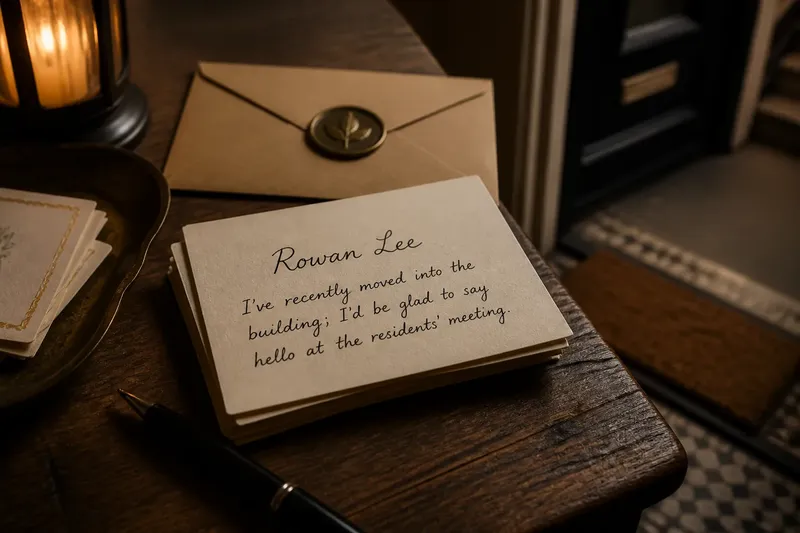
Imagine Rowan has just moved into a block of flats and wants to introduce themself to a neighbour. Rowan writes their name and “I’ve recently moved into the building; I’d be glad to say hello at the residents’ meeting” on a card, then gives it to the meeting organiser to pass on. The neighbour can recognise Rowan’s name at the meeting and choose whether to start a conversation. The card creates an opening, not a promise of friendship.
Useful information fits on a small card
The name is the essential information. Depending on the purpose, a card might also include a title, a household or address, or a few handwritten words. These are possible details, not a universal historical template.
For a present-day neighbourhood introduction, keep the information relevant and avoid adding personal details the recipient does not need. A name, a clear connection to the place and one plain sentence are enough to make a later greeting more natural. A noticeboard sleeve, a recipe card shared at an event or a note passed through an organiser can borrow the principle without claiming to follow historical etiquette.
A delayed reply gives both people room
A card separates arrival from response. The recipient can read it later rather than making a social decision while someone waits at the threshold. The caller, in turn, does not have to improvise a conversation before the household is ready.
That pause can make a first approach less demanding, but it cannot ensure a reply. A recipient may be busy, uninterested or unsure what to say. The point is not to remove uncertainty; it is to make the first contact easier to handle.
Recognition gives a later conversation a starting point
Seeing a name beforehand can make a later meeting less abrupt. The recipient might recognise the caller at a community event and begin with the reason in the note: a recent move, a shared activity or a connection to the building. The card does not replace conversation. It gives conversation a small, usable starting point.
That distinction is useful wherever a newcomer is joining an established group. A name that has already appeared in a familiar setting is easier to connect with its owner than a name requested without context.
Questions about calling cards have straightforward answers
Were calling cards the same as business cards?
No. Calling cards were associated with social visits or introductions, while business cards identified someone in a professional context. Similar appearance does not make their purposes identical.
Did every visitor leave a card?
No. Use depended on local custom, the household and the kind of visit. A card was one possible way to make contact, not a universal rule.
Could a calling card include a message?
A short handwritten note could explain why someone had called or help the recipient place them. Its usefulness depended on clarity, not elaborate wording.
Can the idea still help neighbours meet?
Yes, as a simple introduction rather than a revival of old rules. A name and a clear reason for getting in touch can help someone recognise a new neighbour at a later gathering.
A modest introduction is easier to answer
The useful part of the calling card is the small amount of context it carries before a face-to-face meeting. For a neighbourhood note, include your name, how you are connected to the place and one low-pressure reason to say hello. Calling cards and their social introductions offer a reminder that a first approach can be clear without demanding an immediate answer.