A Hosted Table or a Shared-Potluck Meal?
A hosted table or shared-potluck meal changes who carries the work. Compare costs, guest expectations and planning demands to choose a format that fits.
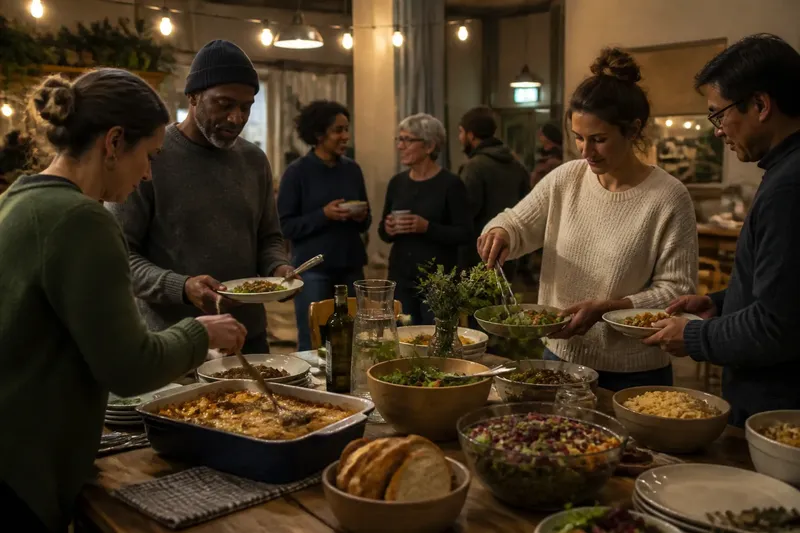
A hosted table or shared-potluck meal gives a neighbourhood gathering a different centre of gravity: one puts most food decisions with the organiser, the other distributes them among guests. Choose by asking who can comfortably carry the work, not which meal sounds more convivial on paper. A table of borrowed serving spoons can be convivial enough.
A hosted table keeps decisions with the organiser
For a hosted meal, one person or a small organising group decides what to serve, buys or prepares it, and takes responsibility for putting it out. Guests arrive without needing to cook, shop or remember a dish on the bus. That makes the invitation easier to accept for people with little spare time, limited kitchen access or uncertainty about what would be welcome.
The organiser has more control over the menu and timing. A large pot of vegetable stew with bread, for instance, can be served when people arrive rather than waiting for several hot dishes to be finished together. But a hosted table also concentrates cost, preparation and the less glamorous work of checking dietary needs, laying out utensils and dealing with leftovers.
This format suits a small gathering, a first event where guests do not yet know one another, or a group that wants a predictable meal. It can also work well when inviting people who might find a contribution difficult. Hosting does not require an elaborate menu: a simple, clearly described spread is easier to plan and less likely to turn the evening into a test of culinary nerve.
A shared-potluck meal distributes the food work
With a potluck, guests bring food to share, while the organiser provides the place, basic tableware and coordination. Contributions can create a sense that people are helping to shape the gathering, rather than arriving as an audience. The organiser may have less cooking to do, but the meal still needs a person to keep its moving parts legible.
Guests need to know what sort of contribution is useful. “Bring something” leaves open whether that means a main dish, a drink, plates or an ambitious tray that requires an oven. A better request gives a broad category, such as a side dish or dessert, and says whether the venue has fridge or reheating space. Avoid assigning every guest an exact item unless the group is small and the organiser can keep track without turning dinner into a rota.
A potluck suits groups whose members enjoy contributing and have the time and means to prepare or buy food. It can be a poor fit if travel is awkward, kitchens are shared, or participation starts to feel like an entrance fee. Make clear that coming without food is still welcome; otherwise the format can quietly exclude the very neighbours the gathering was meant to include.
Food safety and access need practical attention
Either format calls for clear, calm arrangements. Ask guests to identify dishes and common ingredients, and provide a separate serving utensil for each item. Keep food that needs particular handling in appropriate conditions, and make space for people to serve themselves without having to explain personal dietary needs to the whole room.
For a hosted table, the organiser can choose dishes that are easy to describe and serve. For a potluck, a small card beside each dish helps guests decide what suits them. Neither format can promise that every dish will work for every person, so anyone with a serious allergy or other medical dietary requirement may need to check details directly and bring a suitable alternative. Follow food labels, manufacturer instructions and local guidance where these apply.
Accessibility includes more than ingredients. If guests are carrying food, consider the walk from the entrance to the table and whether a dish can be set down easily. If the organiser is providing everything, avoid relying on kitchen equipment or serving arrangements that guests cannot reach. Ask privately about practical needs rather than making someone disclose them at the table.
A hybrid meal can share responsibility without making it compulsory
A third option is a hosted base with optional contributions. The organiser provides the main dish and water; guests who want to bring something can add fruit, bread or a dessert. This keeps a complete meal available even if nobody brings anything, while leaving room for participation.
Say you are arranging a neighbourhood supper in a shared hall and several people will be coming straight from work. You could make a vegetable pasta bake, set out salad and invite anyone who wishes to bring fruit or a non-alcoholic drink. The expected result is a meal that does not depend on late arrivals carrying dinner, while willing guests still have an easy way to contribute.
This approach asks the organiser to plan a reliable base and makes the optional part genuinely optional. It is especially useful when the group includes a mixture of confident cooks and people who would rather arrive empty-handed. Keep the invitation precise about what is already covered, so nobody brings a second main course because the plan sounded mysterious.
Which meal format fits your gathering?
Who should choose a hosted table?
Choose a hosted table when guests may have limited time, transport or cooking facilities, or when a simple menu will help a new group settle in. It places more work on the organiser, so keep the food modest and the guest list within what that organiser can manage.
When does a potluck make sense?
A potluck makes sense when guests are keen to contribute and the venue can accommodate dishes arriving at different times. Give people a useful category to bring and make attendance independent of bringing food.
What should the organiser ask guests?
Ask about dietary needs and practical access in a way that allows a private reply. For a potluck, also ask what people plan to bring and whether it needs chilling or reheating, so the table does not become a queue for one microwave.
How can a group decide without a long discussion?
Consider the group’s likely time, travel and kitchen constraints, then choose the format that makes attending easiest. If those needs vary, provide the main meal and invite optional additions rather than making contribution the price of a place.
Choose the format that asks least of the people you want there
The useful question is not whether a hosted table or shared-potluck meal is more generous. It is where the work will land and whether that arrangement fits the people invited. A hosted meal asks more of the organiser; a potluck asks more of guests; a hybrid shares the load while keeping participation open.
For a neighbourhood gathering, make the food plan clear enough that people know what to expect before they arrive. A straightforward menu, a specific contribution request or an explicitly optional addition can each do the job. The best choice is the one that leaves room at the table for people, rather than requiring them to qualify as cooks first.